
Editorial note — updated April 2026.
This piece was originally published in January 2024 as a snapshot of the AI market sizing landscape at that moment. The figures and forecasts below reflect the consensus estimates available at that time and remain useful as a historical reference for how the AI market was being sized two years ago — particularly the gap between conservative analyst forecasts and the trajectory the sector actually delivered.
Information Matters’ current view on the agentic AI market — which now sits at the centre of the broader AI sector — is in our Q1-2026 agentic AI market report, with the underlying methodology at our methodology page. The headline figure: an estimated $40 billion total addressable market for agentic AI in 2026 (range $33–$48 billion), built bottom-up from primary-source disclosures rather than CAGR extrapolations. The full report covers segment sizing, vendor landscape, and a four-scenario forecast through 2030.
The figures below are preserved unchanged for reference. Where they differ materially from the current numbers, that is itself useful context — the AI market in 2026 looks materially different from how analysts at the start of 2024 expected it to.
AI Market Size and Forecasts
Below is a summary of the latest statistics and forecasts for the rapidly developing artificial intelligence (AI) sector. This includes data on market size of AI services and applications as well as market size data, revenue and spend on AI supporting technologies such as graphics processors and data centers and the impact of AI on economies and productivity..
The data comes from curated and reputable sources including Gartner, Forrester, IDC, McKinsey, Bain, Goldman Sachs, Morgan Stanley etc. Sources are listed as footnotes at the end of this post.
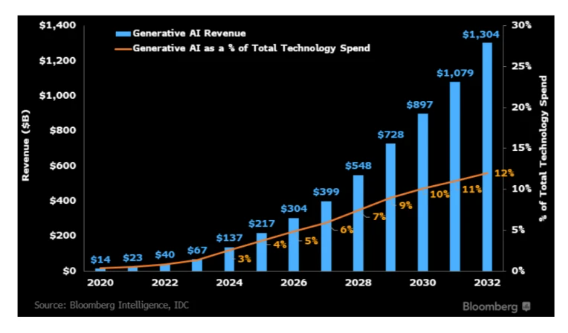
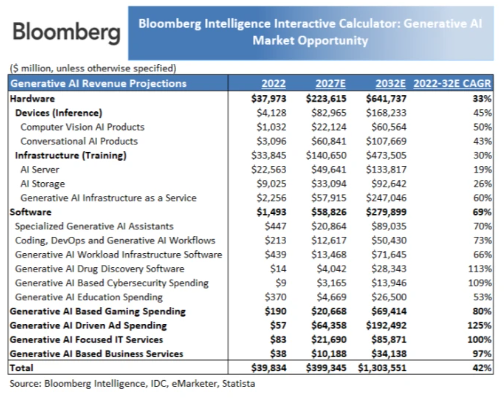
The generative AI market is poised to explode, growing to $1.3 trillion over the next 10 years from a market size of just $40 billion in 2022. The largest drivers of incremental revenue will be generative AI infrastructure as a service ($247 billion by 2032) used for training LLMs, followed by digital ads driven by the technology ($192 billion) and specialized generative AI assistant software ($89 billion). On the hardware side of this, revenue will be driven by AI servers ($132 billion), AI storage ($93 billion), computer vision AI products ($61 billion) and conversational AI devices ($108 billion). [1]https://www.bloomberg.com/company/press/generative-ai-to-become-a-1-3-trillion-market-by-2032-research-finds/
McKinsey analysis suggests that the Total Addressable Market (TAM) from AI can reach $15 trillion. [2]https://www.mckinsey.com/capabilities/mckinsey-digital/our-insights/the-top-trends-in-tech#tech-trends-2023
AI Chips – forecast
Sales of AI chips for data centres would grow to $400bn in 2027 (Lisa Su, Chief Executive of AMD)[3]https://www.ft.com/content/f84bd56f-484d-4393-bafc-4428da6a7873
Semiconductors for executing AI workloads were worth $53.4 billion in 2023, up from $44.16 billion in 2022. This will increase to $67.1 billion in 2024 and reach $119.4 billion by 2027, according to Gartner. In the consumer electronics market, Gartner estimate that AI-enabled application processors used in devices will amount to $1.2 billion in 2023, from $558 million in 2022. [4]https://www.gartner.com/en/newsroom/press-releases/2023-08-22-gartner-forecasts-worldwide-ai-chips-revenue-to-reach-53-billion-dollars-in-2023

AI Investments
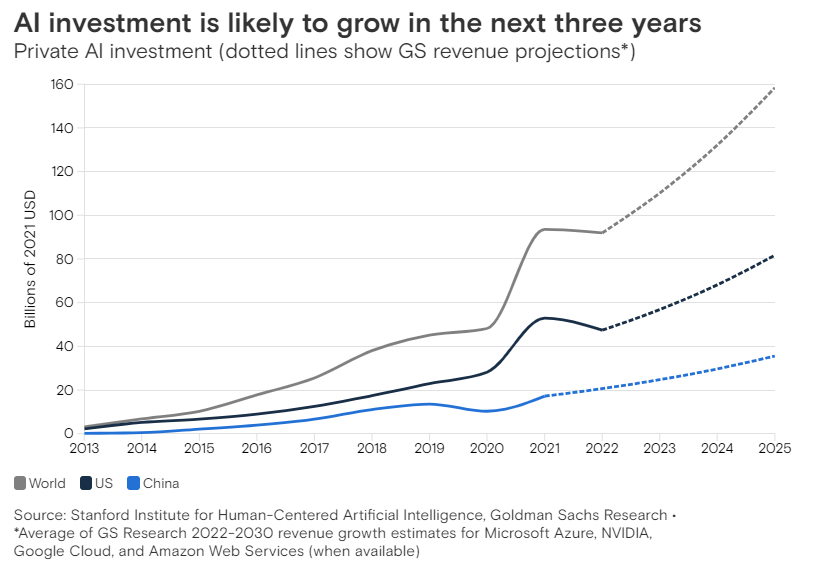
Global AI investments, which could amount to around $200 billion globally by 2025. AI investment could approach $100 billion in the U.S. by 2025. [5]https://www.goldmansachs.com/intelligence/pages/ai-investment-forecast-to-approach-200-billion-globally-by-2025.html
AI Impact on Economies and Productivity
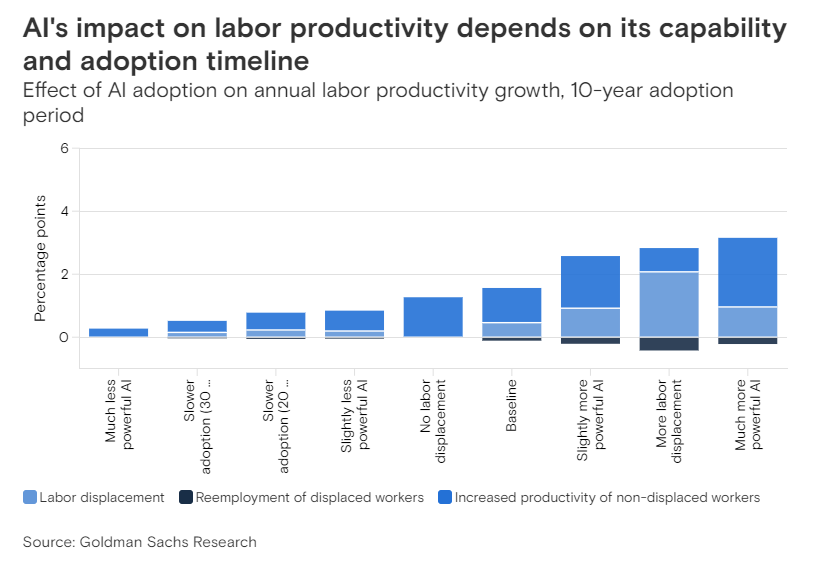
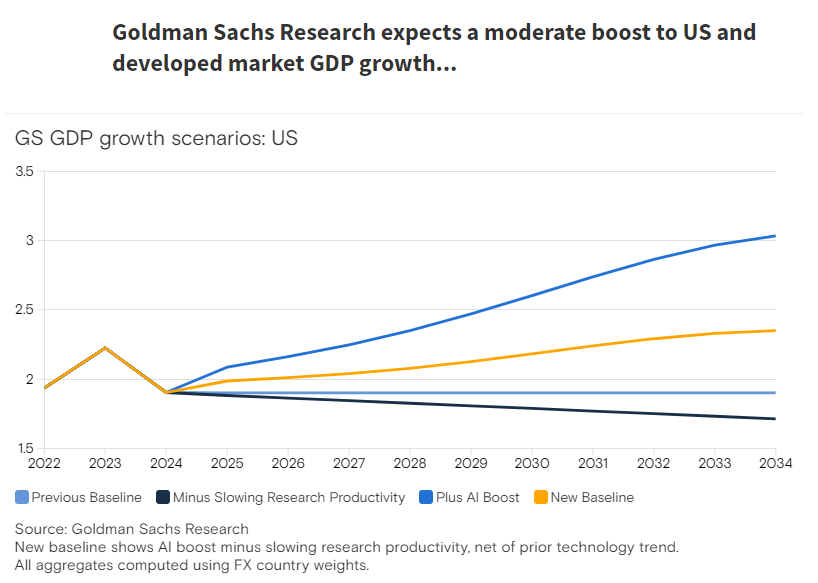
As tools using advances in natural language processing work their way into businesses and society, they could drive a 7% (or almost $7 trillion) increase in global GDP and lift productivity growth by 1.5 percentage points over a 10-year period. [6]https://www.goldmansachs.com/intelligence/pages/generative-ai-could-raise-global-gdp-by-7-percent.html
AI could ultimately automate around 25% of labor tasks in advanced economies and 10-20% of work in emerging economies. [7]https://www.goldmansachs.com/intelligence/pages/ai-may-start-to-boost-us-gdp-in-2027.html
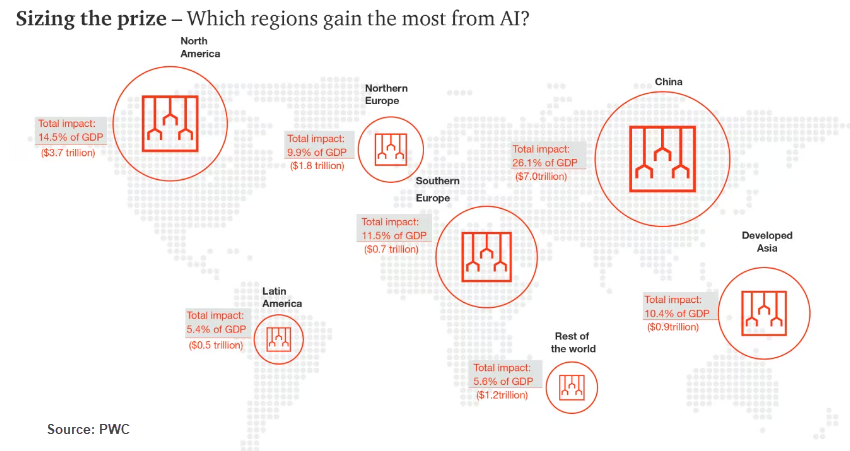
AI could contribute up to $15.7 trillion1 to the global economy in 2030. Of this, $6.6 trillion is likely to come from increased productivity and $9.1 trillion is likely to come from consumption-side effects. [8]https://www.pwc.com/gx/en/issues/data-and-analytics/publications/artificial-intelligence-study.html
Generative AI is poised to add as much as $4.4 trillion in economic value from a combination of specific use cases and more diffuse uses—such as assisting with email drafts—that increase productivity. [9]https://www.mckinsey.com/capabilities/mckinsey-digital/our-insights/the-top-trends-in-tech#tech-trends-2023
AI Software Market Forecasts
Total addressable market for generative AI software to be $150 billion in 2023, compared with $685 billion for the global software industry. [10]https://www.goldmansachs.com/intelligence/pages/generative-ai-could-raise-global-gdp-by-7-percent.html
Demand for generative AI products could add about $280 billion of new software revenue, driven by specialized assistants, new infrastructure products, and copilots that accelerate coding. [11]https://www.bloomberg.com/company/press/generative-ai-to-become-a-1-3-trillion-market-by-2032-research-finds/
Global AI software revenue is expected to grow at a 34.9% CAGR to reach nearly $100bn in 2025. [12]https://omdia.tech.informa.com/OM000884/Artificial-Intelligence-Software-Market-Forecasts
By 2025, the market for artificial intelligence (AI) software will reach almost $134.8 billion. Over the next five years, the market growth will accelerate from 14.4% in 2021 to reach 31.1% in 2025. [13]https://www.gartner.com/guest/purchase/registration?resId=4007140
Worldwide artificial intelligence (AI) software market will grow from $64 billion in 2022 to nearly $251 billion in 2027 at a compound annual growth rate (CAGR) of 31.4%. [14]https://www.idc.com/getdoc.jsp?containerId=prUS51345023
Revenues of generative artificial intelligence (AI) technology offerings are forecast to reach $3.7 billion in 2023 and expand to $36 billion by 2028 with a compound annual growth rate (CAGR) of 58 percent from 2023 to 2028. [15]https://press.spglobal.com/2023-06-08-Generative-AI-Software-Market-Forecast-to-Expand-Near-10-Times-by-2028-to-36-Billion,-S-P-Global-Market-Intelligence-Says
What’s changed since this piece was published
The most consequential developments since January 2024:
The foundation-model layer has consolidated faster than was visible in early 2024. Anthropic, OpenAI, Google, Mistral, and the Chinese foundation-model labs (DeepSeek, Moonshot, MiniMax, Zhipu) now define the substrate the rest of the market builds on. Information Matters treats this layer separately in our market sizing — see the methodology page for the foundation-model attribution rate we apply.
The application layer has split into clearly distinct segments — coding agents, customer-operations agents, evaluation and observability, voice infrastructure, vertical AI in legal and health and finance. Each is now sized separately in our quarterly reports.
The agentic distinction matters more than the generative one. The shift from text-generation AI to multi-step-action AI has reshaped the analytical questions investors and corporate buyers are asking. Our coverage tracks this shift specifically.
For the current state of the market, see our most recent quarterly report and sign up to our weekly newsletter on the agentic AI sector.
References
| ↑1, ↑11 | https://www.bloomberg.com/company/press/generative-ai-to-become-a-1-3-trillion-market-by-2032-research-finds/ |
|---|---|
| ↑2, ↑9 | https://www.mckinsey.com/capabilities/mckinsey-digital/our-insights/the-top-trends-in-tech#tech-trends-2023 |
| ↑3 | https://www.ft.com/content/f84bd56f-484d-4393-bafc-4428da6a7873 |
| ↑4 | https://www.gartner.com/en/newsroom/press-releases/2023-08-22-gartner-forecasts-worldwide-ai-chips-revenue-to-reach-53-billion-dollars-in-2023 |
| ↑5 | https://www.goldmansachs.com/intelligence/pages/ai-investment-forecast-to-approach-200-billion-globally-by-2025.html |
| ↑6, ↑10 | https://www.goldmansachs.com/intelligence/pages/generative-ai-could-raise-global-gdp-by-7-percent.html |
| ↑7 | https://www.goldmansachs.com/intelligence/pages/ai-may-start-to-boost-us-gdp-in-2027.html |
| ↑8 | https://www.pwc.com/gx/en/issues/data-and-analytics/publications/artificial-intelligence-study.html |
| ↑12 | https://omdia.tech.informa.com/OM000884/Artificial-Intelligence-Software-Market-Forecasts |
| ↑13 | https://www.gartner.com/guest/purchase/registration?resId=4007140 |
| ↑14 | https://www.idc.com/getdoc.jsp?containerId=prUS51345023 |
| ↑15 | https://press.spglobal.com/2023-06-08-Generative-AI-Software-Market-Forecast-to-Expand-Near-10-Times-by-2028-to-36-Billion,-S-P-Global-Market-Intelligence-Says |