
The taxman sent your books to the cloud. Where did they land?
Your accounts are the most complete picture of your business that exists — every customer, every supplier, every salary, every bank feed. We looked inside the full audited field of accounting and bookkeeping software sold to UK businesses — thirty-seven companies, forty products — to ask where that picture actually lives, and who controls it. Even Britain’s own accounting champion gave a surprising answer.
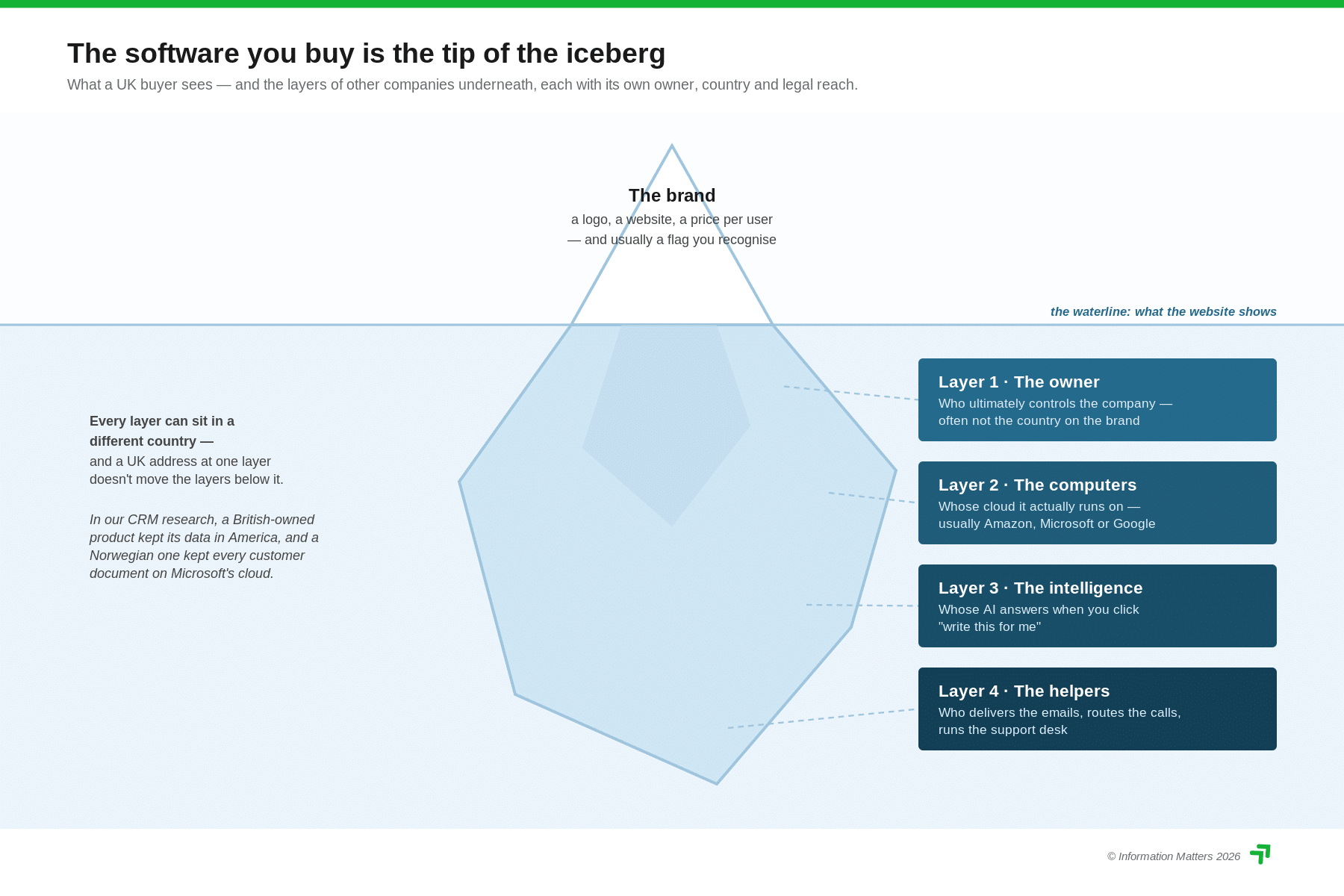
Accounting software is different from every other purchase in one respect: for most UK businesses it stopped being optional. Making Tax Digital (MTD) obliges VAT-registered businesses to keep digital records and file through software, and the same regime is now extending to income tax. The government, quite reasonably, pushed the country’s books into software — but nobody in that process asked, or told you, where the books would physically end up.
So we asked, the same way we did for [CRM systems](2026-06-12-crm-sovereignty-case-study.md): we traced thirty-seven vendors — British, Irish, Dutch, Norwegian and Swedish, German, Canadian, American, Indian, and one with no owner at all — through their own published documents. Who owns the company; where a UK customer’s data is stored; whose computers it runs on; and whose artificial intelligence now reads the ledger.
The headline finding is an uncomfortable one for anyone who buys British by reflex: owning the vendor and holding the data have almost nothing to do with each other.
Britain’s champion keeps the data elsewhere
Sage is the great British software success story — Newcastle-built, FTSE-listed, the default name in UK accounting for forty years. It is genuinely UK-owned; no other vendor on our list at its scale is. And yet: Sage Intacct, the product Sage sells to mid-market UK companies, runs on Amazon Web Services per Sage’s own published sub-processor list — and Sage’s documentation states no UK data region for the product, so where a UK customer’s Intacct books physically sit is not something we could pin down in a free, public source this session. Meanwhile the unfashionable old Sage 50 — the desktop product the industry has spent a decade migrating customers away from — keeps its core data on your own computer, which is, ironically, the strongest data-location position in the entire mainstream market.
Xero tells the same story from the other direction. New Zealand-owned, beloved of UK small businesses and accountants — and its servers are, on Xero’s own statement, “located in the US,” on Amazon. Its sub-processor list now names both OpenAI and Anthropic, two American artificial-intelligence suppliers, alongside AWS. The UK’s two favourite small-business bookkeeping brands keep the books in Ireland and America respectively.
Now the reversal. QuickBooks — as American as software gets — tells UK customers their data is stored “in your home country to satisfy data residency laws,” in the cloud on Amazon Web Services. Oracle’s NetSuite runs on Oracle’s own cloud across data centres in North America, Europe and Asia-Pacific. Microsoft’s Business Central offers a UK data region as standard. Just as with CRM, the American giants are often better at keeping data in Britain than the British and Commonwealth brands are — because they can afford to build everywhere, and the smaller vendors rent whatever cloud region is cheapest.


The field, at a glance
This is the full audited cohort. Ownership country is the ultimate controller’s domicile (where a private-equity owner sits, that is the entry), verified against Companies House, registry filings or the corporate record. “UK data lives” is where a UK customer’s books physically sit, from each vendor’s own data-location or sub-processor documentation; “not disclosed” means the vendor does not say in a free, public source we could read.
| Product | Owned from | UK data lives | Runs on | AI inside |
|---|---|---|---|---|
| QuickBooks Online (Intuit) [1] | USA (listed) | UK (“your home country”) | Intuit-run AWS | Intuit’s own |
| Dynamics 365 Business Central [2] | USA (listed) | UK region | Microsoft end-to-end | Microsoft |
| NetSuite (Oracle) [3] | USA (listed) | Not disclosed (Europe DCs available) | Oracle’s own cloud | Oracle’s own |
| Sage 50 Accounts [4] | UK (listed) | Your own computer (cloud add-ons: Azure/AWS) | Desktop + Azure/AWS components | Not disclosed |
| Sage Intacct [4] | UK (listed) | Not disclosed (no UK region stated) | Amazon | Not disclosed |
| Xero [5] | New Zealand (listed) | USA | Amazon | OpenAI + Anthropic (sub-processors) |
| FreeAgent [6] | UK (NatWest-owned) | Ireland | Amazon (AWS) | Not disclosed |
| IRIS Elements [7] | UK (private equity) | Not disclosed | Not disclosed | Not disclosed |
| KashFlow (IRIS) [7] | UK (private equity) | Not disclosed | Not disclosed | Not disclosed |
| Silverfin (Visma) [8] | UK-controlled PE (Hg) | Not disclosed | Not disclosed | Not disclosed |
| Bokio (Visma) [8] | Sweden (Visma group) | Not disclosed (UK closing 2026) | Not disclosed | Not disclosed |
| Crunch [9] | UK (founder + accountancy-firm co-owner) | EEA | Not disclosed | Not disclosed |
| Clear Books [10] | UK (founder + UK co-owner) | EU (AWS) | Amazon (AWS, EU) | Not disclosed |
| Pandle [11] | UK (founder-owned) | UK (Google Cloud) | Not disclosed | |
| iplicit [12] | UK (founder-led + investor) | UK available | Microsoft Azure | Not disclosed |
| AccountsIQ [13] | UK entity, Irish founders (VC-backed) | Not disclosed | Dimension Data / NTT | Not disclosed |
| Capium [14] | UK (controller not disclosed) | UK (UK servers) | Not disclosed | Not disclosed |
| Countingup [15] | UK (VC-backed; Sage + ING investors) | UK (+ EEA) | Not disclosed | Not disclosed |
| Coconut [16] | UK (founder vehicle) | EEA | Not disclosed | Not disclosed |
| Capitalise [17] | UK (founder vehicle) | Not disclosed | Not disclosed | Not disclosed |
| ANNA Money [18] | UK (founder-owned) | UK | Not disclosed | Not disclosed |
| Aqilla [19] | UK entity, Channel Islands control | UK (G-Cloud) | Amazon (AWS, UK) | Not disclosed |
| AccountancyManager (Bright) [20] | UK entity, Bright/Hg PE (Ireland HQ) | Not disclosed | Not disclosed | Not disclosed |
| BTCSoftware (Bright) [20] | UK entity, Bright/Hg PE (Ireland HQ) | UK (Solution Cloud) | Amazon (AWS, UK) | Not disclosed |
| Nomisma (Nomi) [21] | UK (founder-owned) | Not disclosed | Not disclosed | Not disclosed |
| Easy Digital Filing [22] | UK (founder-owned) | UK only (own servers) | Own UK servers | Not disclosed |
| GoSimpleTax [23] | UK (founder vehicle) | UK (ANS hosting) | ANS (UK) | Not disclosed |
| untied [24] | UK (founder-owned) | UK / EEA | AWS / Google / Microsoft | Not disclosed |
| Mayday [25] | UK (founder-owned) | Not disclosed | Amazon (AWS) | Not disclosed |
| Float [26] | UK (founder-led) | Not disclosed | Not disclosed | Not disclosed |
| VT Software [27] | UK (founder-owned, independent) | Your own computer (desktop) | Desktop | Not disclosed |
| Sum-It (TOTAL) [28] | UK (founder-owned) | Your own computer (on-prem) | On-premise | n/a |
| TaxCalc [29] | UK topco (PE buyout; controller not disclosed) | Mythic Beasts (UK) + AWS backup | Mythic Beasts (UK) / desktop | Not disclosed |
| Exact Online [30] | USA (KKR) — NL operating co | Not disclosed (EEA processing stated) | Not disclosed | Not disclosed |
| Twinfield (Wolters Kluwer) [31] | Netherlands (listed) | “Europe” — no UK option stated | Not disclosed | Not disclosed |
| CCH iFirm (Wolters Kluwer) [31] | Netherlands (listed) | Not disclosed | Not disclosed | Not disclosed |
| FreshBooks [32] | Canada (VC-backed) | US / non-EU (UK via SCCs) | Not disclosed | Not disclosed |
| Zoho Books [33] | India (family-owned) | EEA + US (no live UK DC) | Zoho’s own servers | Zoho’s own |
| Akaunting [34] | USA Inc. (founder-led) | Self-host / not disclosed | Self-host / not disclosed | Not disclosed |
| GnuCash [35] | Nobody — community project, no company | Your own computer | Your own computer | n/a |
DATEV — the German platform owned cooperatively by the accountants who use it — is the most sovereignty-friendly ownership structure in European accounting software, but it is not sold in the UK, so it sits outside the table [36].

Size changes everything — but differently this time
In CRM, large UK enterprises had essentially no UK-owned option. Accounting is kinder to Britain in ownership terms: Sage covers small to mid-market, IRIS and iplicit serve practices and mid-market companies, and a deep bench of founder-owned UK firms (Pandle, Clear Books, Crunch, ANNA, Countingup, Easy Digital Filing, GoSimpleTax, Nomisma, VT, Sum-It) serve the small end and the self-employed. The catch is that UK ownership buys you less location certainty than you’d think. Of the UK-owned vendors, only a handful clearly keep data in Britain — Pandle (Google Cloud UK), ANNA, Countingup, Easy Digital Filing and GoSimpleTax (UK hosting), iplicit (UK Azure region available), the desktop products (Sage 50, VT, Sum-It), and TaxCalc’s UK hosting partner. Against them: FreeAgent’s data sits in Ireland, Crunch’s and Coconut’s “in the EEA,” Sage Intacct states no UK region, and a long list of UK-owned vendors — IRIS Elements, KashFlow, Capium, Capitalise, Aqilla, AccountancyManager, BTCSoftware, Nomisma, untied, Mayday, Float — simply do not say.
Two ownership labels in the audited list deserve a footnote. TaxCalc is often described as owned by a US private-equity house; the public register shows only that its publisher was bought in October 2024 through a UK “topco” that files a “no registrable person” statement — so no ultimate owner is named in the primary record, and we have downgraded the cell accordingly. Bokio is part of the Visma group and is a Swedish, not Norwegian, operating company — “Bokio Group AB,” built, on its own site, “in Gothenburg and Stockholm.” It is also leaving the UK: Bokio’s own homepage states the UK service will close in 2026 and urges customers to export their data, so for a UK buyer it is effectively exiting the field. And the sharpest contrast in the whole field is German: DATEV, member-owned by the accountants who use it, an ownership model with no investor to sell to — which simply never crossed the Channel.
Three ironies worth sitting with
The retired technology was the sovereign one. Desktop accounting — Sage 50, VT Software, Sum-It’s farm-accounts package, GnuCash — keeps the ledger on your own machine, under your own lock. The cloud migration that the industry (and, indirectly, Making Tax Digital) drove was also a migration of every UK ledger onto rented, mostly American, infrastructure. Nobody decided that; it happened as a side-effect. GnuCash remains the purest case in our whole research programme: free, open-source, runs entirely on your own computer, and owned by no one — there is no company to be acquired, repriced, or compelled.
The artificial intelligence is reading the books now. Xero’s sub-processor list names OpenAI and Anthropic; Intuit, Oracle and Zoho run their own models. Accounting data is the most sensitive feed yet offered to these systems — and as with CRM, the AI layer is the least disclosed layer in every vendor’s documentation. Most vendors in the field say nothing at all about whose AI, if any, touches the ledger; even Sage, whose sub-processor list we read in full, does not name an AI supplier for its assistant in that document.
The licence trap repeats. Of the open-source candidates, GnuCash is the real thing — fully open, owned by no company. But Akaunting, marketed as open source, ships under a restricted Business Source Licence that caps production use at two users and one company until each version ages four years, and the licensing entity is a US “Inc.,” not the Turkish founder-firm the marketing implies. Read the licence, not the homepage.

What a UK buyer can actually do
The same six questions as for CRM apply — who ultimately owns you; where exactly is my data and can I choose; whose cloud is underneath; whose AI reads my data and can I switch it off; who else touches it; what happens if you’re sold. For accounting, add a seventh: “If I leave, how do I get seven years of records out?” — HMRC expects you to keep them, and export is where cloud accounting lock-in really bites.
And the dial works the same way. Take the default with your eyes open (QuickBooks, with its home-country statement, is better than its reputation here). Pin the data down where a UK region exists (Business Central, iplicit, and the UK-hosted small-business set — Pandle, ANNA, Countingup, Easy Digital Filing, GoSimpleTax). Prefer UK-owned and UK-hosted at the small end (Pandle is the quiet champion). Or run it yourself (VT Software, Sum-It, GnuCash) and accept the homework. What you can no longer do — and Sage Intacct is the proof, with no stated UK region for its mid-market product — is assume that buying from a British company keeps British books in Britain.

Sources
All facts are taken from each vendor’s own published documentation (privacy, security, data-location and sub-processor pages) and from company registries (Companies House, SEC, Euronext) and corporate press releases, read directly during June 2026. One reference per vendor; where a vendor discloses no hosting or data location, the ownership source is listed. Where a fact is shown as “not disclosed” in the table, no free, public primary source stating it could be read this session.
- Intuit (QuickBooks) — privacy & data location: https://quickbooks.intuit.com/learn-support/en-uk/help-article/banking/privacy-security-quickbooks/L7q2gUqfM_GB_en_GB ; corporate: https://www.intuit.com/privacy/
- Microsoft (Business Central) — service/data region: https://learn.microsoft.com/en-us/dynamics365/business-central/dev-itpro/service-overview
- Oracle (NetSuite) — infrastructure: https://www.netsuite.com/portal/platform/infrastructure.shtml
- Sage (Sage 50, Sage Intacct) — Companies House: https://find-and-update.company-information.service.gov.uk/company/02231246 ; sub-processors: https://www.sage.com/en-gb/-/media/images/sagedotcom/master/global/feature/pdf/legal/sages-sub-processors.pdf ; privacy notice: https://www.sage.com/en-gb/legal/privacy/
- Xero — sub-processors (OpenAI, Anthropic, AWS): https://www.xero.com/uk/legal/xero-subprocessors/ ; data location (“servers located in the US”): https://www.xero.com/uk/data/xero-and-gdpr/
- FreeAgent — NatWest ownership: https://www.natwestgroup.com/who-we-are/our-brands/freeagent.html ; security (Ireland / AWS): https://www.freeagent.com/features/security/
- IRIS (IRIS Elements, KashFlow) — Companies House PSC: https://find-and-update.company-information.service.gov.uk/company/06266887/persons-with-significant-control ; product: https://www.iris.co.uk/products/iris-kashflow-bookkeeping/
- Visma (Silverfin, Bokio) — Silverfin security: https://www.silverfin.com/security ; Bokio (Visma group; “Bokio Group AB,” Gothenburg/Stockholm; UK closure notice): https://www.bokio.co.uk/
- Crunch — Companies House PSC: https://find-and-update.company-information.service.gov.uk/company/06014477/persons-with-significant-control ; privacy: https://www.crunch.co.uk/privacy-policy
- Clear Books — Companies House PSC: https://find-and-update.company-information.service.gov.uk/company/06636109/persons-with-significant-control
- Pandle — Companies House PSC: https://find-and-update.company-information.service.gov.uk/company/07083629/persons-with-significant-control ; privacy (Google Cloud, UK servers): https://www.pandle.com/privacy-policy/
- iplicit — Companies House: https://find-and-update.company-information.service.gov.uk/company/03207522 ; G-Cloud listing (UK hosting): https://www.applytosupply.digitalmarketplace.service.gov.uk/g-cloud/services/693404684326001
- AccountsIQ — Companies House PSC: https://find-and-update.company-information.service.gov.uk/company/06578522/persons-with-significant-control ; security (Dimension Data/NTT): https://www.accountsiq.com/security
- Capium — Companies House PSC: https://find-and-update.company-information.service.gov.uk/company/08438321/persons-with-significant-control
- Countingup — Companies House PSC: https://find-and-update.company-information.service.gov.uk/company/10729748/persons-with-significant-control ; privacy (UK + EEA): https://countingup.com/privacy/
- Coconut — Companies House PSC: https://find-and-update.company-information.service.gov.uk/company/09904418/persons-with-significant-control ; privacy: https://www.getcoconut.com/legal/privacy-policy
- Capitalise — Companies House PSC: https://find-and-update.company-information.service.gov.uk/company/09256446/persons-with-significant-control
- ANNA Money — Companies House PSC: https://find-and-update.company-information.service.gov.uk/company/15218883/persons-with-significant-control ; privacy (UK data centres): https://anna.money/privacy-policy/
- Aqilla — Companies House PSC: https://find-and-update.company-information.service.gov.uk/company/05732888/persons-with-significant-control
- AccountancyManager & BTCSoftware (Bright Software Group / Hg) — Companies House PSC: https://find-and-update.company-information.service.gov.uk/company/10658933/persons-with-significant-control ; https://find-and-update.company-information.service.gov.uk/company/04539303/persons-with-significant-control
- Nomisma (Nomi) — Companies House PSC: https://find-and-update.company-information.service.gov.uk/company/08511463/persons-with-significant-control
- Easy Digital Filing (Comdal Ltd) — Companies House PSC: https://find-and-update.company-information.service.gov.uk/company/07958931/persons-with-significant-control ; data (UK-only servers): https://www.easydigitalfiling.com/public/gdpr-information
- GoSimpleTax — Companies House PSC: https://find-and-update.company-information.service.gov.uk/company/08793323/persons-with-significant-control ; privacy (ANS, UK servers): https://www.gosimpletax.com/privacy-policy/
- untied — Companies House search: https://find-and-update.company-information.service.gov.uk/search?q=untied
- Mayday — Companies House search: https://find-and-update.company-information.service.gov.uk/search?q=mayday
- Float (cash-flow forecasting) — corporate: https://floatapp.com/
- VT Software — about (independent, founder-owned): https://www.vtsoftware.co.uk/about.htm
- Sum-It Computer Systems (TOTAL) — Companies House PSC: https://find-and-update.company-information.service.gov.uk/company/01348014/persons-with-significant-control
- TaxCalc (Acorah Software Products Ltd) — Companies House PSC (Malbec topco, no registrable person): https://find-and-update.company-information.service.gov.uk/company/16038449/persons-with-significant-control ; hosting (Mythic Beasts UK + AWS): https://www.taxcalc.com/legal
- Exact (Exact Online) — ownership (Apax→KKR, 2019): https://www.apax.com/news-views/kkr-to-acquire-exact-software-from-funds-advised-by-apax-partners/ ; privacy: https://www.exact.com/trust/privacy/privacy-statement
- Wolters Kluwer (Twinfield, CCH iFirm) — corporate/investor: https://www.wolterskluwer.com/en/about-us
- FreshBooks (2ndSite Inc.) — privacy (US / non-EU): https://www.freshbooks.com/policies/privacy
- Zoho (Zoho Books) — privacy (EEA + US): https://www.zoho.com/privacy.html
- Akaunting — licence (BSL 1.1, US Inc.): https://akaunting.com/license
- GnuCash — community project (no company): https://www.gnucash.org/donate.phtml
- DATEV — cooperative company structure: https://www.datev.com/about-datev/company-structure
*Data-residency sources (browser-render pass, June 2026): Aqilla — UK data, hosted with AWS, per its G-Cloud 14 service listing stating
Research notes: all facts are taken from vendors’ own published documentation — data-residency, security, sub-processor and privacy pages — and company registries, read directly during June 2026. Where a vendor’s data-location, cloud or AI supplier is not publicly disclosed, the cell reads “not disclosed” rather than a guess. Locations and supplier lists change; check current documents before relying on them. This article reflects the opinions of the Information Matters team — human and AI — and should not be considered statements of fact.
If you have any questions or comments about this article please email info@informationmatters.net