
Editorial note — the IM 2030 figure has since been revised.
This piece sets out an earlier Information Matters forecast: a $52 billion global agentic AI market by 2030. That figure has been superseded by the analysis in our Q1-2026 agentic AI market report, which puts the 2030 central case at $140 billion, with a four-scenario range of $88 billion (bear) to $215 billion (bull).
The two figures are not a contradiction. The earlier $52B forecast measured what we now refer to as the application-and-infrastructure stack only. The current $140B central case adds the foundation-model layer’s agentic-attributable share — the substrate that drives the application layer’s growth. The methodology section of the Q1-2026 report explains the reconciliation in detail; our public methodology page covers the foundation-model attribution rate that drives the difference.
The body of this piece is preserved unchanged for reference. Where its analysis differs from the current view, that’s a useful record of how Information Matters’ market sizing has evolved as the foundation-model layer has become a more central part of the agentic AI story.
The transition from generative AI to agentic systems marks a fundamental shift in how businesses interact with technology. While standard large language models act as sophisticated engines for text prediction, agentic AI is defined by its ability to reason, plan, use tools, and operate autonomously toward high-level goals.
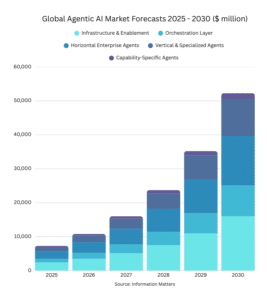
The recently released report, Global Market Forecasts 2025–2030, by Information Matters, provides a comprehensive look at this evolving landscape. Valued at approximately USD 7.3 billion in 2025 and growing to USD 52 billion by 2030, the agentic AI market is moving beyond simple “copilots” toward collaborative, autonomous teams capable of managing complex, multi-step workflows.
A Specialized Market Taxonomy
To understand where value is being created, the report segments the market into five primary layers:
- Infrastructure & Enablement: The foundational “pick and shovel” phase, currently leading the market with a $2.40 billion valuation in 2025. This includes agent development platforms (IDEs), infrastructure frameworks, and data curation.
- Horizontal Enterprise Agents: These are established agents used in structured workflows like Customer Operations (CX) and IT/Security, which together accounted for $2.18 billion in 2025.
- Vertical & Specialized Agents: Focused on high-stakes industries such as Legal, Healthcare, and Coding, this segment held a $1.25 billion share in 2025.
- Orchestration Layer: This critical segment, valued at $1.12 billion in 2025, focuses on multi-agent coordination and state management.
- Capability-Specific Agents: Focused on niche digital senses like Voice/Audio and Web Search, representing a $350 million market in 2025.
Key Drivers and Adoption Trends
The report highlights that 88% of executives plan to increase AI budgets specifically for agentic AI. Currently, the strongest returns on investment (ROI) are being seen in IT operations (35%) and marketing (30%).
Efficiency is driving the “Ready-to-Deploy” trend; 64.18% of the market currently consists of plug-and-play models. Enterprises are choosing these over custom-built solutions to bypass high implementation costs and immediate skills gaps. While large enterprises (250+ employees) command 71.4% of global revenue, the rise of “Agent-as-a-Service” models is rapidly democratizing access for small and medium-sized businesses.
The Reliability Dilemma
Despite the rapid growth, a “Reliability and Control Dilemma” remains the primary bottleneck for the industry. There is a significant gap in trust depending on the task: while 38% of users trust agents for routine data analysis, that number drops to just 20% for high-stakes financial transactions.
Why Download the Report?
As we move toward a future of collaborative autonomous teams, understanding the architectural stack and market taxonomy is vital for any enterprise leader. This report offers a roadmap for the “what’s next” in the agentic AI revolution, providing the strategic analysis needed to navigate this $7.3 billion (and growing) ecosystem.
Buy the report OR download a free sample
Current Information Matters view
- Q1-2026 agentic AI market report — current sizing, segment analysis, and the four-scenario forecast through 2030.
- Our methodology — including the foundation-model attribution rate that explains why the 2030 central case has moved from $52B to $140B.
- Subscribe to The Information Matters Brief — Information Matters’ weekly news commentary on the agentic AI sector, written for investors, vendors and corporate buyers. Free.